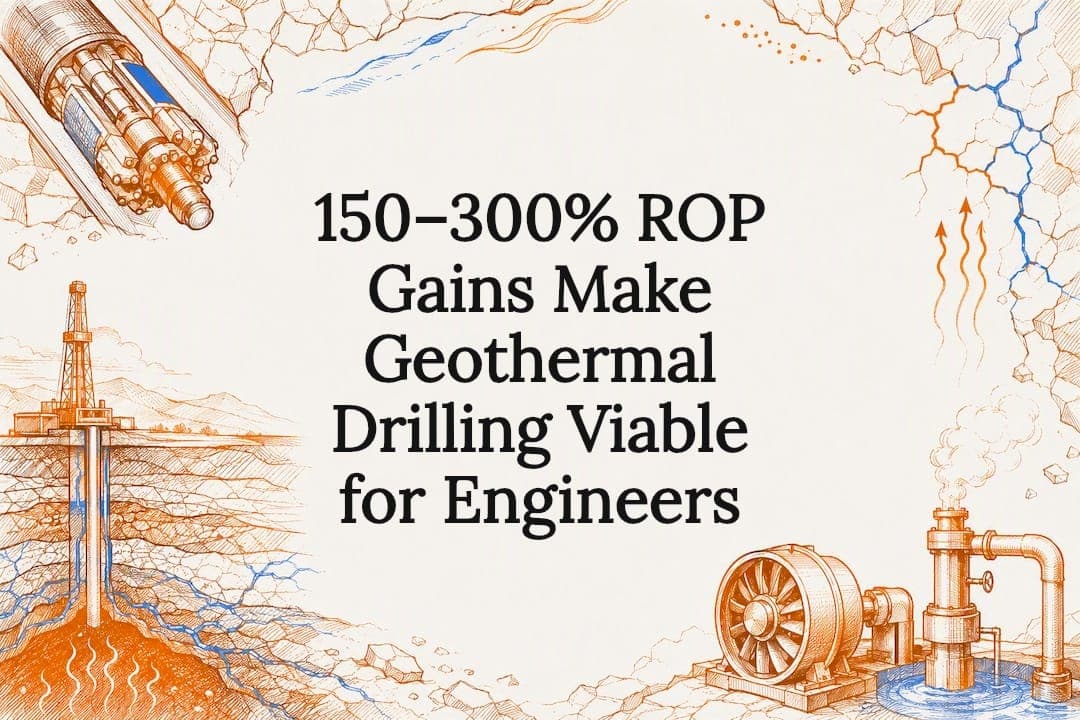
Recent geothermal drilling advances have moved deep, high-temperature enhanced geothermal systems (EGS) from theory to field-proven practice. At Newberry Volcano, a twinned well demonstration posted 150 to 300 percent gains in rate of penetration and cut on-bottom time by roughly 45 percent, with tools surviving reliably above 300°C. The engineering priority now shifts from proving concepts to standardizing high-temperature electronics and thermal-mechanical modeling across new pilot sites.
TL;DR:
- Deep geothermal drilling has achieved up to an 80 percent reduction in costs and a 150 to 300 percent increase in drill rate of penetration at Newberry Volcano.
- High-temperature electronics now operate reliably above 300°C, enabling tools that can withstand more extreme conditions and improve drilling precision.
- Rock-melting and laser drilling methods show promise but require enormous energy inputs and face unresolved power and cooling issues for practical field deployment.
- Integrated system design, including optimized BHA configuration and thermal management, was key to Newberry's success in reaching target depths and maintaining tool survivability.
- Further progress depends on developing materials for sustained 300°C service, validating high-temperature stimulation models, and incorporating seismic monitoring into early-stage project planning.
Table of Contents
- What Recent Geothermal Drilling Advances Have Actually Measured
- High-Temperature Tools and Rock-Melting Methods Changing the Game
- Drilling System Design That Made Newberry Work
- Managing Induced Seismicity in EGS Stimulation
- Cost Curves and What Scaling EGS Actually Requires
- Where DOE, FORGE, and Field Pilots Are Headed Next
- The Boss Mind Perspective: Priorities For Researchers And Funders
- Field Reports and Research Worth Reading
- Sources
- FAQ
What Recent Geothermal Drilling Advances Have Actually Measured
The numbers coming out of recent field demonstrations are the first hard evidence that deep EGS drilling can compete on cost and schedule, not just on resource potential. A pilot project tied to the Newberry twinned well program documented some of the strongest figures published to date for high-temperature geothermal work.
- Up to an 80 percent reduction in drilling costs compared to conventional offset geothermal wells
- A notable cut in on-bottom drilling time
- A 150 to 300 percent increase in average rate of penetration (ROP)
The Newberry case matters beyond the headline stats because it validated something harder to quantify: placement precision and tool survivability at extreme depth and heat. Engineers hit target trajectories within a few meters while running bottom hole assemblies (BHAs) that held together above 300°C, a threshold that has historically destroyed conventional drilling electronics. DOE-backed demonstrations built on this project confirm the metrics are repeatable, not a one-off result. What these numbers don't yet resolve is scalability across variable basement rock. Newberry proved the method works in one geologic setting. Whether the same ROP gains transfer to sites with different mineralogy and stress regimes is the next open question.
High-Temperature Tools and Rock-Melting Methods Changing the Game
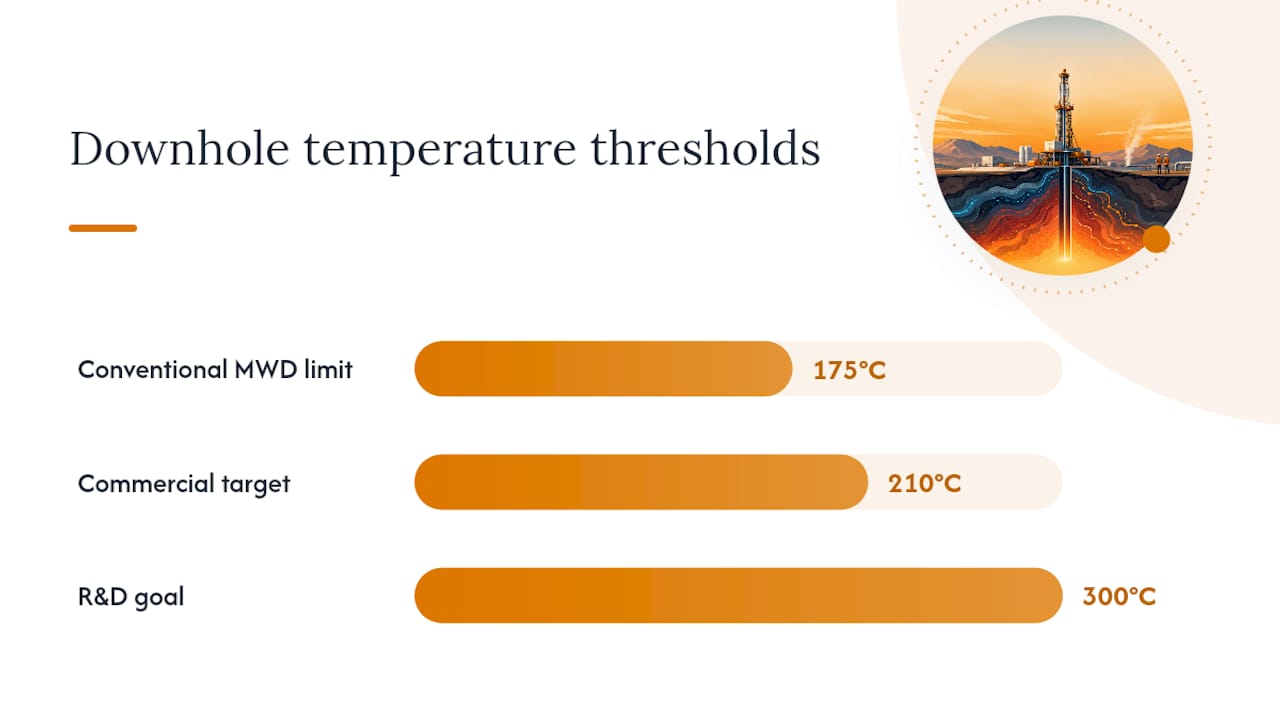
Every advance in deep EGS drilling traces back to one constraint: electronics degrade fast above 175°C, the ceiling that has governed conventional oil and gas measurement-while-drilling (MWD) tools for decades. Breaking past that ceiling is the single biggest lever in geothermal energy technology today.
Current commercial and near-commercial MWD systems now target operating thresholds around 210°C, with active research and development pushing toward sustained 300°C-plus reliability. That gap, roughly 90°C of additional tolerance, represents years of materials science work on sensor packaging, downhole batteries, and telemetry components that were never designed for superhot service.
Alongside incremental MWD improvements, a separate category of next-generation methods is drawing serious attention from researchers:
- Millimeter-wave and rock-melting drilling. These approaches vaporize or melt rock directly instead of grinding through it mechanically, a concept championed by companies like Quaise and covered in MIT Energy Initiative's assessment of next-generation geothermal. The appeal is depth independence from bit wear, but field pilots remain early stage.
- Laser drilling. Still largely lab-bound, laser methods promise fast rock removal without mechanical contact, though power delivery at depth remains unsolved.
- High-pressure water jet drilling. Better suited to shallower boreholes and geothermal well arrays, this mechanical method avoids some thermal exposure issues but has limited reach in true deep EGS applications.
Each method trades something for its benefit. Rock-melting reduces bit wear but demands enormous energy input. Laser methods reduce mechanical stress but face unresolved power and cooling questions. High-pressure water jets work well shallow but lose efficiency with depth.
Pro Tip: When evaluating a next-generation drilling method for a pilot program, weigh tool survivability against energy input first. A method that melts rock efficiently but destroys its own emitter after 40 meters isn't a deployable geothermal well development solution yet, no matter how fast its theoretical ROP looks on paper.
Drilling System Design That Made Newberry Work
Newberry's performance gains didn't come from a single breakthrough tool. They came from an integrated system design where every component was tuned for extreme heat and depth simultaneously. Three design pillars stand out for engineers planning similar deep geothermal drilling programs.
- BHA configuration and bit selection. High-inertia collars combined with PDC (polycrystalline diamond compact) bits reduced torsional vibration, a major cause of tool failure in superhot wells. Conservative RPM settings, rather than software-based stick-slip mitigation alone, kept the drivetrain stable during extended runs.
- Thermal management protocols. Circulation regimes and fluid selection were tuned to manage cumulative thermal exposure, the running total of heat electronics absorb over a well's full drilling cycle, not just peak bottomhole temperature. This distinction prevented premature electronics failure that peak-temperature specs alone would have missed.
- Real-time parameter optimization. Continuous adjustment of weight on bit (WOB), RPM, and hydraulics let crews respond to changing formation conditions mid-run. This iterative feedback loop, informed by validated thermal-mechanical trajectory planning, is what let engineers hit meter-scale placement accuracy and avoid thermal short-circuiting between injection and production wells.
That third point deserves emphasis. Thermal short-circuiting, where injected fluid flows too directly to the production well without adequately absorbing heat, can quietly wreck a project's energy output long after drilling wraps up. Precision placement isn't a nicety here. It's the difference between a commercially viable well pair and an expensive dry run.
Managing Induced Seismicity in EGS Stimulation
Creating permeability in hot, largely impermeable basement rock is still the core technical hurdle in enhanced geothermal systems. Hydraulic stimulation, essentially pumping fluid at pressure to open and connect fracture networks, remains the dominant method, but it carries a well-documented seismic risk that the industry can no longer treat as an afterthought.
The 2017 Pohang earthquake in South Korea, linked to geothermal fracking activity, remains the field's clearest cautionary example. Research covered by ScienceNews tied that magnitude 5.5 event to fluid injection at an EGS site, a result that reshaped regulatory and operational thinking industry-wide.
Three stimulation approaches now compete for use depending on formation and risk tolerance:
- Hydraulic stimulation remains the default for opening new fracture networks, though it demands the most careful pressure management.
- Cyclic stimulation applies pressure in pulses rather than continuously; lab and modeling work suggest this can reduce breakdown pressure and increase fracture complexity, though validation above 200°C is still limited.
- Thermal stimulation exploits temperature-driven rock stress changes to open existing fractures, often as a lower-risk complement to hydraulic methods.
Real-time seismic monitoring arrays, staged injection protocols, and defined trigger thresholds for pausing or reducing pump pressure are now standard practice at serious EGS sites, not optional add-ons.
Cost Curves and What Scaling EGS Actually Requires
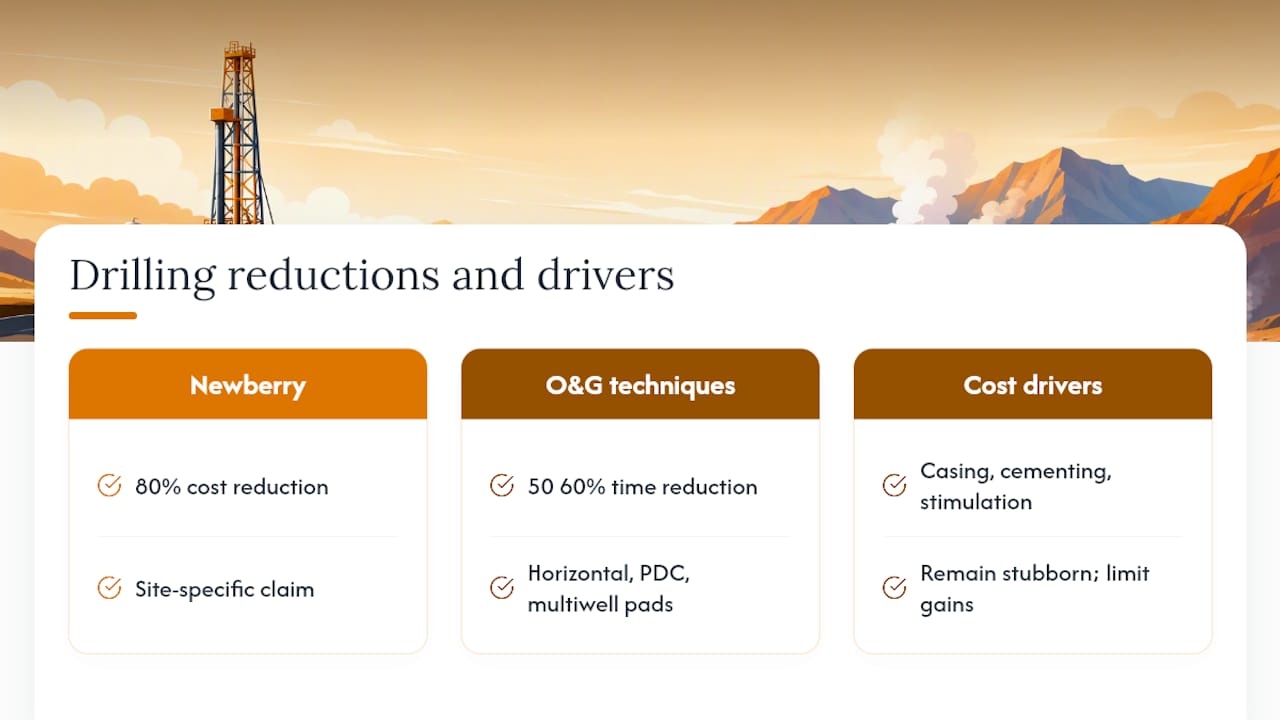
Newberry's 80 percent cost reduction claim is real but site-specific; it won't automatically repeat everywhere. The more durable signal comes from broader adoption of oil and gas techniques. Peer-reviewed analysis shows horizontal drilling, PDC bits, and multiwell pads have cut EGS drilling time by 50 to 70 percent on some projects, a learning-curve effect familiar from shale development. Casing, cementing, and stimulation complexity remain the stubborn cost drivers where further drilling technology gains will matter most.
Where DOE, FORGE, and Field Pilots Are Headed Next
The DOE Geothermal Technologies Office coordinates the field infrastructure making this progress measurable, running FORGE, EGS Pilot Demonstrations, and GEODE and Wells of Opportunity initiatives that generate the performance data researchers now cite. Commercial pilots from companies like Fervo, alongside projects such as Project Red and Cape Station, are adding real-world field data outside pure research settings.
Near-term priorities are clear: materials capable of sustained 300°C-plus service, stimulation models validated at high temperature, and cement and casing systems tested for long-term thermal cycling. Teams designing new pilots should prioritize continuous ROP and NPT logging alongside seismic monitoring from day one, since that combined dataset is what turns a single successful well into a repeatable engineering standard.
The Boss Mind Perspective: Priorities For Researchers And Funders
The 300°C electronics barrier deserves more R&D dollars than it currently gets, relative to flashier rock-melting concepts that remain years from field maturity. Integrated thermal-mechanical modeling, not any single tool, is what actually produced Newberry's results, and funders should reward teams building that modeling discipline over teams chasing a single hardware breakthrough. Reversible permeability methods, which manage induced seismicity by design rather than by reaction, deserve equal funding priority. Engineering teams preparing pilots should build seismic monitoring and staged validation into the budget from the first well, not as a compliance afterthought.
— Steven
Field Reports and Research Worth Reading
- DOE Geothermal Drilling Research: federal program overview and testbed access
- Newberry Case Study, Stanford: field-measured performance data
- MIT Energy Initiative: next-generation method landscape
- ScienceNews on induced seismicity: Pohang risk analysis
- Nature Review on EGS: technology transfer from oil and gas
- MDPI hydraulic fracturing review: stimulation method modeling
For ongoing analysis on how emerging drilling and energy technologies reshape investment and policy decisions, The Boss Mind tracks the engineering advances that matter most to decision-makers.
Sources
- Twinned at 300°C+: High-Performance Geothermal Drilling — Newberry Case Study
- Geothermal Drilling Research — U.S. Department of Energy
- Next-geothermal energy: Promise, progress, and challenges — MIT Energy Initiative
- ScienceNews article on induced seismicity (Pohang)
- High-temperature drilling technology seminar — University of Houston / Petro
FAQ
What is the status of geothermal energy in 2026?
Deep EGS is moving past pilot status, with drilling advances from projects like Newberry demonstrating that hotter, deeper wells can be drilled faster and cheaper than earlier conventional approaches allowed.
What is the biggest problem with geothermal energy?
Creating and managing permeability in hot basement rock without triggering induced seismicity remains the central technical challenge, requiring careful real-time monitoring and controlled-pressure injection protocols.
What is the new IPO stock for geothermal?
No specific geothermal IPO stock is confirmed at this time; readers should consult financial disclosures and regulatory filings directly rather than rely on informal market speculation.
What country is leading in geothermal energy?
The United States hosts major federally backed research infrastructure through DOE's FORGE and GEODE programs, positioning it among the leading countries advancing next-generation geothermal drilling technology.