Overnight capital costs for small modular reactors currently span a range covering several thousand dollars per kilowatt depending on design maturity, with levelized cost of electricity estimates generally clustering around eighty to ninety dollars per megawatt hour for well-specified designs. First-of-a-kind projects run well above those figures, and operating costs, capacity factors, and policy support all swing final economics as much as the sticker price does. Budget with realistic contingency margins reflecting substantial uncertainties.
TL;DR:
- First-of-a-kind SMR projects typically cost around $18,646 per kilowatt, while fleet-average costs are closer to $12,653 per kW, indicating significant premium for early units.
- Site work, civil construction, and interest during construction are the main drivers of cost variability and can add tens of millions of dollars or more per project depending on location and schedule delays.
- Operating costs, including refueling cycles and capacity factor, may outweigh capital savings in market competitiveness if the plant's efficiency or reliability decreases.
- Federal policy credits like the Production Tax Credit and Investment Tax Credit significantly influence project viability, with timing and design costs affecting eligibility and economic outcomes.
- Budgeting should involve multiple scenarios with contingencies of 25-40% for FOAK projects, reducing to 5-15% for mature, multi-unit fleet deployments to account for uncertainty.
Table of Contents
- Small Modular Reactor Cost Benchmarks From Real Projects
- What Actually Makes Up the Overnight Capital Cost
- LCOE and Operating Costs: The Number That Actually Decides Competitiveness
- How the Inflation Reduction Act Changes the Math
- FOAK vs. NOAK: Turning Uncertainty Into a Contingency Number
- Building a Budget Boards Will Actually Approve
- Our Method: How We Normalize Competing SMR Cost Studies
- Executive Takeaway: Where SMRs Make Financial Sense Today
- Get a Custom Small Modular Reactor Cost Model From Thebossmind
- Sources
- FAQ
Small Modular Reactor Cost Benchmarks From Real Projects
Nobody budgets off a spreadsheet forever. At some point the number has to come from a project that actually poured concrete, and two examples dominate the current conversation on small modular reactor cost: the Darlington New Nuclear Project in Canada and NuScale Power's design work in the United States.
Ontario Power Generation's four-unit BWRX-300 program at Darlington carries a published price tag of roughly CAD 20.9 billion. Converted into per-kilowatt terms across the full fleet, that works out to approximately $12,653 per kW. The first unit alone, once you allocate shared site infrastructure like cooling systems and access works, comes in closer to $18,646 per kW. That gap between fleet average and first-unit cost is the clearest real-world illustration of the FOAK premium you'll find in any current SMR program.
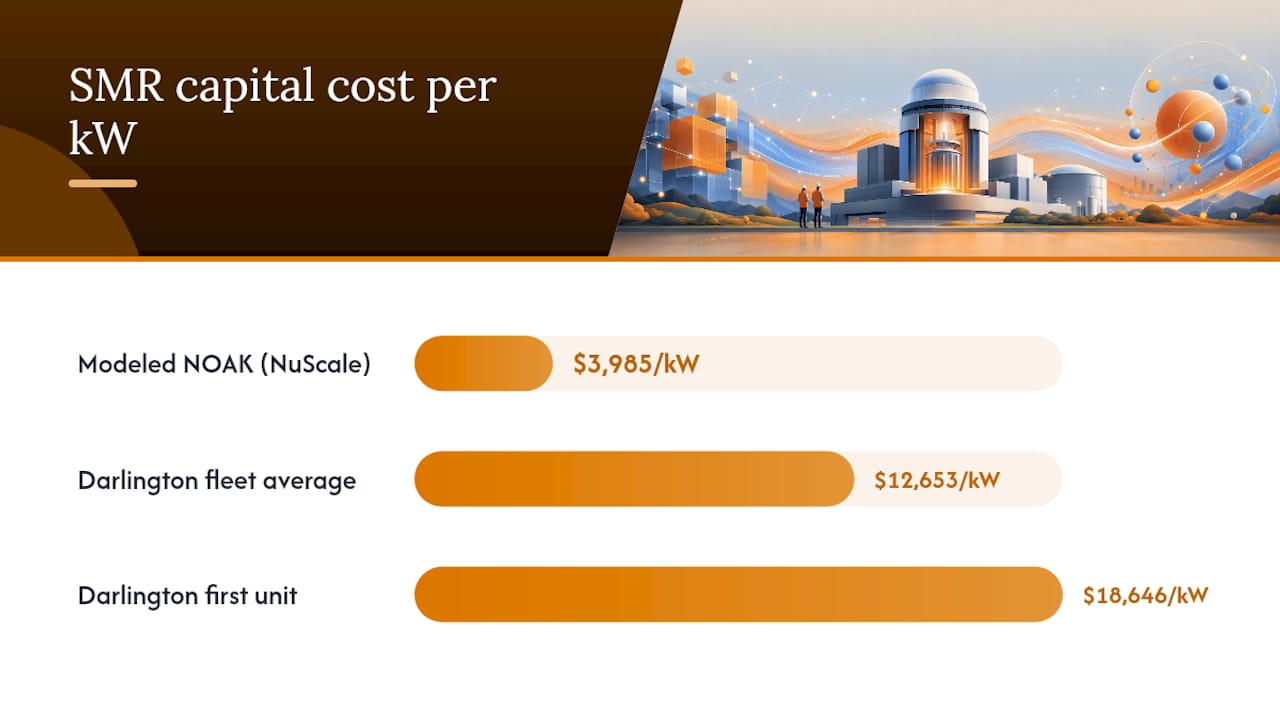
NuScale's numbers tell a similar story from a different angle. Bottom-up techno-economic modeling of NuScale-class and comparable light-water SMR designs puts overnight capital costs in the range of $3,985 to $4,844 per kW, with corresponding LCOE estimates around $80 to $90 per MWh. Those figures represent engineered, design-specific studies rather than a single built project, so treat them as a technical floor rather than a construction-tested price.
A few things to keep straight when you compare these numbers:
- Darlington's figure is a real, disclosed construction budget; NuScale's is a bottom-up cost model based on design data, not a signed contract.
- Currency and year basis matter. CAD-to-USD conversions and inflation assumptions shift per-kW math by hundreds of dollars.
- Fleet averages flatter the economics. First-unit costs are what actually hits your balance sheet if you're the first customer.
Statistic to anchor your model: the observed spread between a modeled NOAK design ($3,985/kW) and a real first-unit build (~$18,646/kW) is nearly fivefold. That range, not any single point estimate, is the honest starting position for small modular reactor cost planning today.
What Actually Makes Up the Overnight Capital Cost
Overnight capital cost (OCC) is the hypothetical price of building the plant instantly, with no financing charges or schedule risk layered in. It's the baseline every LCOE model starts from, and it breaks into a handful of predictable buckets.
Direct costs, meaning the reactor module itself, the balance-of-plant equipment, turbines, and structures, typically account for the majority of OCC in mature designs. Indirect costs, covering engineering, project management, and owner's costs, make up the remainder and tend to be proportionally larger in FOAK projects because there's no established playbook yet to compress them.
Four factors drive most of the volatility:
- Site work and civil construction. Cooling infrastructure, tunnels, and grid interconnection can vary by tens of millions of dollars depending on terrain and existing site infrastructure, which is exactly why Darlington's first unit carries such a heavy premium.
- Labor and skilled trades availability. Nuclear-qualified welders and inspectors are a limited pool, and a regional shortage shows up directly in schedule and cost.
- Equipment lead times. Long-lead reactor components ordered from a limited supplier base can shift delivery by quarters, which compounds into interest during construction.
- Interest during construction (IDC). Every month a project's schedule slips adds carrying cost on borrowed capital, and IDC alone can add a meaningful share to total project cost on a multi-year build.
Modularization is supposed to change this equation, and to some extent it does. Factory-built modules shift labor cost from an expensive, schedule-sensitive union site crew to a controlled factory environment where the same crew builds unit after unit with less variability. The catch: that benefit only materializes at fleet scale. A single factory-built module shipped to one site still carries the tooling, transport, and one-off engineering costs that would otherwise be amortized across dozens of units.
Pro Tip: When reviewing a vendor's cost proposal, ask specifically how many units their per-kW figure assumes. A number quoted "at scale" for a tenth unit is not the number you'll pay for unit one, and vendors rarely volunteer that distinction unprompted.
LCOE and Operating Costs: The Number That Actually Decides Competitiveness
A low capital cost doesn't guarantee a competitive plant. Once construction is finished, operating and maintenance costs, refueling cycles, and capacity factor determine whether the electricity that plant produces can actually compete in a wholesale market, and this is where a lot of SMR optimism runs into a wall.
Recent U.S. analyses put variable O&M for SMR designs in a range that, combined with fixed O&M baselines, can materially outweigh the benefit of a lower capital cost if the plant runs at reduced capacity factor. Modeling of SMR economics in competitive electricity markets finds that high operating and marginal costs can make a plant uneconomic even when its capital cost looks reasonable on paper. The same research notes that cutting marginal costs delivers as much or more market value as cutting investment costs, which inverts a lot of conventional SMR marketing that leads with capital price alone.
Capacity factor and refueling design matter here too. A design with longer refueling intervals and higher achievable capacity factor spreads its fixed costs over more delivered megawatt hours, which lowers LCOE independent of any capital cost change. Conversely, a design that requires frequent outages for refueling or maintenance erodes the economics no matter how cheap the modules were to build.
The number that matters most: in wholesale power markets, a plant with elevated marginal cost can be undercut by cheaper dispatchable alternatives even after policy support, according to the same market-modeling work. That's a structural reason SMRs aiming at pure grid electricity face a harder economic case than SMRs serving industrial customers who value reliability and decarbonization over lowest-price power.
- Fixed O&M typically scales with plant size but less than proportionally for smaller units, eroding some of the "small is cheaper" intuition.
- Variable O&M and fuel cycle costs depend heavily on design (light-water vs. advanced non-light-water) and refueling frequency.
- Dispatch modeling suggests operating cost reductions can matter as much as capital cost reductions for market viability.
How the Inflation Reduction Act Changes the Math
Federal policy is not a footnote to small modular reactor pricing right now. It is often the difference between a project penciling out and a project sitting on a shelf.
The Production Tax Credit (PTC) and Investment Tax Credit (ITC) work differently, and the choice between them should be driven by a project's own cost profile. Analysis of IRA effects on SMR economics finds the PTC generally helps projects with higher variable O&M, since it rewards ongoing generation rather than upfront spend. The ITC, by contrast, is more valuable for designs with higher capital costs relative to operating costs, because it directly offsets the construction bill rather than paying out over years of operation.
In low-price wholesale markets like ERCOT in Texas, the same research finds that only SMR designs with very low capital and operating costs are viable without one of these credits. That's a narrow window, and it puts real weight on getting the credit selection right.
A few practical implications for anyone modeling net cost:
- Run both PTC and ITC scenarios before committing; the better credit depends on your specific capital-to-O&M ratio, not a rule of thumb.
- Rate-based recovery mechanisms, sometimes called Regulated Asset Base (RAB) models, can lower the effective cost of capital for regulated utilities by shifting construction risk to ratepayers over time, which changes project viability independent of federal credits.
- Credit windows have expiration dates tied to legislation. A project timeline that slips past a credit's phase-down schedule can lose a meaningful share of its projected return, so financing timelines need to be built around policy calendars, not just construction schedules.
FOAK vs. NOAK: Turning Uncertainty Into a Contingency Number
Every cost figure attached to an SMR right now carries an implicit label: first-of-a-kind or nth-of-a-kind. Confusing the two is the single most common budgeting mistake in this sector.
Bottom-up Monte Carlo modeling from DOE-funded techno-economic work puts mean OCC for light-water SMR designs near $5,233/kW, with a 90% probability interval running from roughly $4,254/kW to $6,399/kW. Those bands exist precisely because no one has built enough of these plants yet to collapse the uncertainty.
For procurement purposes, three numbers matter more than any single point estimate:
- Set your base case from bottom-up studies, not marketing decks. The $3,985 to $4,844/kW range from peer-reviewed modeling is a more defensible planning anchor than a vendor's optimistic quote.
- Apply a FOAK contingency of 25 to 40 percent on top of any modeled OCC figure if you're the first or an early customer for a given design, reflecting the disproportionate share of site infrastructure and learning costs that early units absorb.
- Drop that contingency to 5 to 15 percent for NOAK contracts, once a design has multiple built units and the supply chain has matured, but only if your contract explicitly ties pricing to a stated unit number in a fleet.
The IEA has set a 2040 construction cost target of roughly $4,500 per kW for the U.S. and Europe as the level needed for accelerated SMR uptake. Compare that target against Darlington's first-unit figure near $18,646/kW, and the distance between today's real-world FOAK cost and tomorrow's policy target becomes the honest measure of how much learning curve this industry still has to climb.
Building a Budget Boards Will Actually Approve
Translating all of this into something a CFO can sign off on means building three scenarios, not one number.
A base case should use bottom-up NOAK-adjacent figures (the $3,985 to $4,844/kW range) with a moderate contingency around 20 percent, assuming a design with at least one prior built unit. A downside case should assume FOAK conditions: apply the 25 to 40 percent contingency band, price in a construction schedule at the upper end of the 3.4 to 6.0 year Monte Carlo range, and assume no policy credit captured due to timing risk. An upside case should reflect fleet economics closer to Darlington's $12,653/kW blended figure, with full PTC or ITC capture and a construction schedule near the 4.5-year mean.
On the procurement side, a few contract structures shift real risk off your balance sheet:
- Fixed-price module supply contracts push schedule and equipment cost risk onto the reactor vendor rather than the buyer, at the cost of a pricing premium.
- Milestone-based payment structures tied to verified construction progress reduce the buyer's exposure to vendor cash-flow problems mid-build.
- Shared-risk fleet agreements, where per-unit pricing steps down as more units are ordered, let early customers capture some NOAK benefit without waiting for a mature supply chain.
Before signing anything, require vendors and financiers to answer a specific due-diligence list: What unit number does this quoted price assume? What is the Monte Carlo or sensitivity range behind the headline OCC figure? How is interest during construction handled if the schedule slips? What decommissioning fund contribution is built into the O&M assumptions, and is it sized against a peer-reviewed estimate or an internal vendor figure?
Pro Tip: Ask every vendor to show their cost estimate broken into direct costs, indirect costs, and contingency as three separate line items. A vendor unwilling to unbundle those numbers is usually hiding where the real risk sits.
Our Method: How We Normalize Competing SMR Cost Studies
This analysis synthesizes bottom-up techno-economic studies, Monte Carlo sensitivity modeling, and disclosed project budgets, normalizing figures across currency, inflation year, and FOAK/NOAK basis so decision-makers can compare studies that otherwise use incompatible assumptions. That normalization work, reconciling a Canadian dollar construction budget against a U.S. peer-reviewed cost model, for instance, is where most of the analytical value sits, since raw figures from different sources rarely share a common baseline. Readers evaluating a specific project or design can request the underlying scenario spreadsheets and assumption sets behind any figure cited here.
Executive Takeaway: Where SMRs Make Financial Sense Today
The strongest near-term case for small modular reactors isn't wholesale electricity. It's industrial heat and hydrogen production, where IRA credits make the economics work in a way pure grid power rarely does yet. Boards evaluating an SMR investment should time procurement to policy windows, not construction convenience, since a credit that expires mid-build can erase a project's margin. Regulators and financiers should prioritize funding mechanisms that reduce cost of capital, since that lever often moves LCOE more than any single equipment cost improvement will.
— Steven
Get a Custom Small Modular Reactor Cost Model From Thebossmind
The numbers in this article are a starting point, not a substitute for a model built around your specific site, design choice, and financing structure. Specialists in this kind of normalized scenario work take disparate vendor claims, bottom-up studies, and disclosed project budgets and reconcile them into a single defensible cost band for your board or investment committee.

If you're preparing a capital request or evaluating a vendor bid, a service can build a tailored scenario package covering base, downside, and upside cases, complete with contingency recommendations calibrated to your project's FOAK or NOAK position. Visit Thebossmind to commission a custom report or request the underlying data package behind any figure in this analysis.
Sources
For original data and deeper modeling, consult the IEA's SMR construction cost dashboard, peer-reviewed techno-economic studies in journals like Applied Energy, DOE/OSTI working papers on Monte Carlo cost modeling, and OPG's public Darlington project disclosures.
- The consequences of high SMR operating costs in electricity markets (arXiv, 2026)
- Techno-economic analysis of advanced small modular nuclear reactors (Applied Energy, 2023)
- Small Modular Reactor Statistics 2026: Real Cost per kW (Axis Intelligence)
FAQ
How long do SMR reactors last?
Most SMR designs target operating lifespans of around 40 years, similar to conventional large reactors, though actual figures depend on the specific design's licensing basis.
Are SMRs profitable?
Profitability depends heavily on the use case: modeling shows SMRs can be profitable for industrial hydrogen and process heat under IRA credits, but they're generally uneconomic for dedicated wholesale electricity generation without policy support.
Is nuclear cheaper than solar?
Utility-scale solar generally has a lower LCOE than nuclear, including SMRs, in most U.S. markets today, though nuclear offers dispatchable, high-capacity-factor power that solar cannot match without added storage costs.
Is it illegal to build a mini nuclear reactor?
No, but it is heavily regulated. Building any nuclear reactor, small modular or otherwise, requires licensing through national nuclear regulators (such as the U.S. Nuclear Regulatory Commission), and compliance costs are a material part of overall project budgets.